
Origin-
As a military officer, Robert Baden-Powell was stationed in British India and Africa in the 1880s and 1890s. Baden-Powell claimed that since his youth, he had been fond of woodcraft and military scouting and, as part of their training, showed his men how to survive in the wilderness. Baden-Powell claimed he noticed that it helped the soldiers to develop independence rather than just blindly follow officers' orders.
In 1896, Baden-Powell was assigned to the Matabeleland region in Southern Rhodesia (now Zimbabwe) as Chief of Staff to Gen. Frederick Carrington during the Second Matabele War, and it was here that he first met and began a lifelong friendship with Frederick Russell Burnham, the American born Chief of Scouts for the British. This would become a formative experience for Baden-Powell not only because he had the time of his life commanding reconnaissance missions into enemy territory, but because many of his later Boy Scout ideas took hold here. During their joint scouting patrols into the Matobo Hills, Burnham began teaching Baden-Powell woodcraft, inspiring him and giving him the plan for both the program and the code of honor of Scouting for Boys. Practiced by frontiersmen of the American Old West and Indigenous peoples of the Americas, woodcraft was generally unknown to the British, but well known to the American scout Burnham. These skills eventually formed the basis of what is now called scout craft, the fundamentals of Scouting. Both men recognised that wars in Africa were changing markedly and the British Army needed to adapt; so during their joint scouting missions, Baden-Powell and Burnham discussed the concept of a broad training programme in woodcraft for young men, rich in exploration, tracking, field craft, and self-reliance. It was also during this time in the Matobo Hills that Baden-Powell first started to wear his signature campaign hat like the one worn by Burnham, and it was here that Baden-Powell acquired his Kudu horn, the Ndebele war instrument he later used every morning at Brownsea Island to wake the first Boy Scouts and to call them together in training courses.
Three years later, in South Africa during the Second Boer War, Baden-Powell was besieged in the small town of Mafeking by a much larger Boer army (the Siege of Mafeking). The Mafeking Cadet Corps was a group of youths that supported the troops by carrying messages, which freed the men for military duties and kept the boys occupied during the long siege. The Cadet Corps performed well, helping in the defense of the town (1899–1900), and were one of the many factors that inspired Baden-Powell to form the Scouting movement. Each member received a badge that illustrated a combined compass point and spearhead. The badge's logo was similar to the fleur-de-lis that Scouting later adopted as its international symbol.
In the United Kingdom, the public followed Baden-Powell's struggle to hold Mafeking through newspapers, and when the siege was broken, he had become a national hero. This rise to fame fuelled the sales of a small instruction book he had written about military scouting, Aids to Scouting.
On his return to England, he noticed that boys showed considerable interest in the book, which was used by teachers and youth organizations. He was urged to rewrite this book for boys, especially during an inspection of the Boys' Brigade, a large youth movement drilled with military precision. Baden-Powell thought this would not be attractive and suggested that it could grow much larger when scouting would be used. He studied other schemes, parts of which he used for Scouting.
In July 1906, Ernest Thompson Seton sent Baden-Powell a copy of his book The Birchbark Roll of the Woodcraft Indians. Seton, a British-born Canadian-American living in the United States, met Baden-Powell in October 1906, and they shared ideas about youth training programs.[19][20] In 1907 Baden-Powell wrote a draft called Boy Patrols. In the same year, to test his ideas, he gathered 21 boys of mixed social backgrounds (from boy's schools in the London area and a section of boys from the Poole, Parkstone, Hamworthy, Bournemouth, and Winton Boys' Brigade units) and held a week-long camp in August on Brownsea Islandin Poole Harbour, Dorset, England. His organizational method, now known as the Patrol System and a key part of Scouting training, allowed the boys to organize themselves into small groups with an elected patrol leader.
In the autumn of 1907, Baden-Powell went on an extensive speaking tour arranged by his publisher, Arthur Pearson, to promote his forthcoming book, Scouting for Boys. He had not simply rewritten his Aids to Scouting, but left out the military aspects and transferred the techniques (mainly survival) to non-military heroes: backwoodsmen, explorers (and later on, sailors and airmen). He also added innovative educational principles (the Scout method) by which he extended the attractive game to a personal mental education.
The following year, Baden-Powell wrote a series of magazines, Scouting for Boys, setting out activities and programmes which existing youth organisations could make use of. The reaction was phenomenal, and quite unexpected. In very short time, Scout Patrols were created up and down the country, all following the principles of Baden-Powell's book. By the time of the first census in 1910, there were over 100,000 members of the Movement.
Scouting for Boys first appeared in England in January 1908 as six fortnightly installments, and was published in England later in 1908 in book form. The book is now the fourth-bestselling title of all time, and is now commonly considered the first version of the Boy Scout Handbook.
At the time, Baden-Powell intended that the scheme would be used by established organizations, in particular the Boys' Brigade, from the founder William A. Smith. However, because of the popularity of his person and the adventurous outdoor game he wrote about, boys spontaneously formed Scout patrols and flooded Baden-Powell with requests for assistance. He encouraged them, and the Scouting movement developed momentum. As the movement grew, Sea Scout,Air Scout, and other specialized units were added to the program.
Growth-
The Boy Scout movement swiftly established itself throughout the British Empire soon after the publication of Scouting for Boys. The first recognized overseas unit was chartered in Gibraltar in 1908, followed quickly by a unit in Malta. Canada became the first overseas dominion with a sanctioned Boy Scout program, followed by Australia, New Zealand and South Africa. Chile was the first country outside the British dominions to have a recognized Scouting program. The first Scout rally, held in 1909 at The Crystal Palace in London, attracted 10,000 boys and a number of girls. By 1910, Argentina, Denmark, Finland, France,Germany, Greece, India, Malaya, Mexico, the Netherlands, Norway, Russia, Sweden, and the United States had Boy Scouts.
The program initially focused on boys aged 11 to 18, but as the movement grew, the need became apparent for leader training and programs for younger boys, older boys, and girls. The first Cub Scout and Rover Scout programs were in place by the late 1910s They operated independently until they obtained official recognition from their home country's Scouting organization. In the United States, attempts at Cub programs began as early as 1911, but official recognition was not obtained until 1930.[
Girls wanted to become part of the movement almost as soon as it began. Baden-Powell and his sister Agnes Baden-Powell introduced the Girl Guides in 1910, a parallel movement for girls, sometimes named Girl Scouts. Agnes Baden-Powell became the first president of the Girl Guides when it was formed in 1910, at the request of the girls who attended the Crystal Palace Rally. In 1914, she started Rosebuds—later renamed Brownies—for younger girls. She stepped down as president of the Girl Guides in 1920 in favor of Robert's wife Olave Baden-Powell, who was named Chief Guide (for England) in 1918 and World Chief Guide in 1930. At that time, girls were expected to remain separate from boys because of societal standards, though co-educational youth groups did exist. By the 1990s, two thirds of the Scout organizations belonging to WOSM had become co-educational.
Baden-Powell could not single-handedly advise all groups who requested his assistance. Early Scoutmaster training camps were held in London and Yorkshire in 1910 and 1911. Baden-Powell wanted the training to be as practical as possible to encourage other adults to take leadership roles, so the Wood Badge course was developed to recognize adult leadership training. The development of the training was delayed by World War I, so the first Wood Badge course was not held until 1919. Wood Badge is used by Boy Scout associations and combined Boy Scout and Girl Guide associations in many countries. Gilwell Park near London was purchased in 1919 on behalf of The Scout Association as an adult training site and Scouting campsite. Baden-Powell wrote a book, Aids to Scoutmastership, to help Scouting Leaders, and wrote other handbooks for the use of the new Scouting sections, such as Cub Scouts and Girl Guides. One of these was Rovering to Success, written for Rover Scouts in 1922. A wide range of leader training exists in 2007, from basic to program-specific, including the Wood Badge training.



Influences-
Important elements of traditional Scouting have their origins in Baden-Powell's experiences in education and military training. He was a 50-year-old retired army general when he founded Scouting, and his revolutionary ideas inspired thousands of young people, from all parts of society, to get involved in activities that most had never contemplated. Comparable organizations in the English-speaking world are the Boys' Brigade and the non-militaristic Woodcraft Folk; however, they never matched the development and growth of Scouting.
Aspects of Scouting practice have been criticized as too militaristic. Military-style uniforms, badges of rank, flag ceremonies, and brass bands were commonly accepted in the early years because they were a part of normal society, but since then have diminished or been abandoned in both Scouting and society.
Local influences have also been a strong part of Scouting. By adopting and modifying local ideologies, Scouting has been able to find acceptance in a wide variety of cultures. In the United States, Scouting uses images drawn from the U.S. frontier experience. This includes not only its selection of animal badges for Cub Scouts, but the underlying assumption that American native peoples are more closely connected with nature and therefore have special wilderness survival skills which can be used as part of the training program. By contrast, British Scouting makes use of imagery drawn from the Indian subcontinent, because that region was a significant focus in the early years of Scouting. Baden-Powell's personal experiences in India led him to adopt Rudyard Kipling's The Jungle Book as a major influence for the Cub Scouts; for example, the name used for the Cub Scout leader, Akela (whose name was also appropriated for the Webelos), is that of the leader of the wolf pack in the book.
The name "Scouting" seems to have been inspired by the important and romantic role played by military scouts performing reconnaissance in the wars of the time. In fact, Baden-Powell wrote his original military training book, Aids To Scouting, because he saw the need for the improved training of British military-enlisted scouts, particularly in initiative, self-reliance, and observational skills. The book's popularity with young boys surprised him. As he adapted the book as Scouting for Boys, it seems natural that the movement adopted the names Scouting and Boy Scouts.
"Duty to God" is a principle of Scouting, though it is applied differently in various countries. The Boy Scouts of America (BSA) take a strong position, excluding atheists. The Scout Association in the United Kingdom permits variations to its Promise, in order to accommodate different religious obligations,. As of the beginning of 2014, United Kingdom Scouts will no longer be required to pledge loyalty to God. Scouts Canada defines Duty to God broadly in terms of "adherence to spiritual principles" and leaves it to the individual member or leader whether they can follow a Scout Promise that includes Duty to God.
Scouting is taught using the Scout method, which incorporates an informal educational system that emphasizes practical activities in the outdoors. Programs exist for Scouts ranging in age from 6 to 25 (though age limits vary slightly by country), and program specifics target Scouts in a manner appropriate to their age.



Scout method-
The Scout method is the principal method by which the Scouting organizations, boy and girl, operate their units. WOSM describes Scouting as "...a voluntary nonpolitical educational movement for young people open to all without distinction of origin, race or creed, in accordance with the purpose, principles and method conceived by the Founder..." It is the goal of Scouting "to contribute to the development of young people in achieving their full physical, intellectual, social and spiritual potentials as individuals, as responsible citizens and as members of their local, national and international communities."
The principles of Scouting describe a code of behavior for all members, and characterize the movement. The Scout method is a progressive system designed to achieve these goals, comprising seven elements: law and promise, learning by doing, team system, symbolic framework, personal progression, nature, and adult support. While community service is a major element of both the WOSM and WAGGGS programs, WAGGGS includes it as an extra element of the Scout method: service in the community.
The Scout Law and Promise embody the joint values of the Scouting movement worldwide, and bind all Scouting associations together. The emphasis on "learning by doing" provides experiences and hands-on orientation as a practical method of learning and building self-confidence. Small groups build unity, camaraderie, and a close-knit fraternal atmosphere. These experiences, along with an emphasis on trustworthiness and personal honor, help to develop responsibility, character, self-reliance, self-confidence, reliability, and readiness; which eventually lead to collaboration and leadership. A program with a variety of progressive and attractive activities expands a Scout's horizon and bonds the Scout even more to the group. Activities and games provide an enjoyable way to develop skills such as dexterity. In an outdoor setting, they also provide contact with the natural environment.
Since the birth of Scouting, Scouts worldwide have taken a Scout Promise to live up to ideals of the movement, and subscribe to the Scout Law. The form of the promise and laws have varied slightly by country and over time, but must fulfil the requirements of the WOSM to qualify a National Scout Association for membership.
The Scout Motto, 'Be Prepared', has been used in various languages by millions of Scouts since 1907. Less well-known is the Scout Slogan, 'Do a good turn daily'.
Activities-
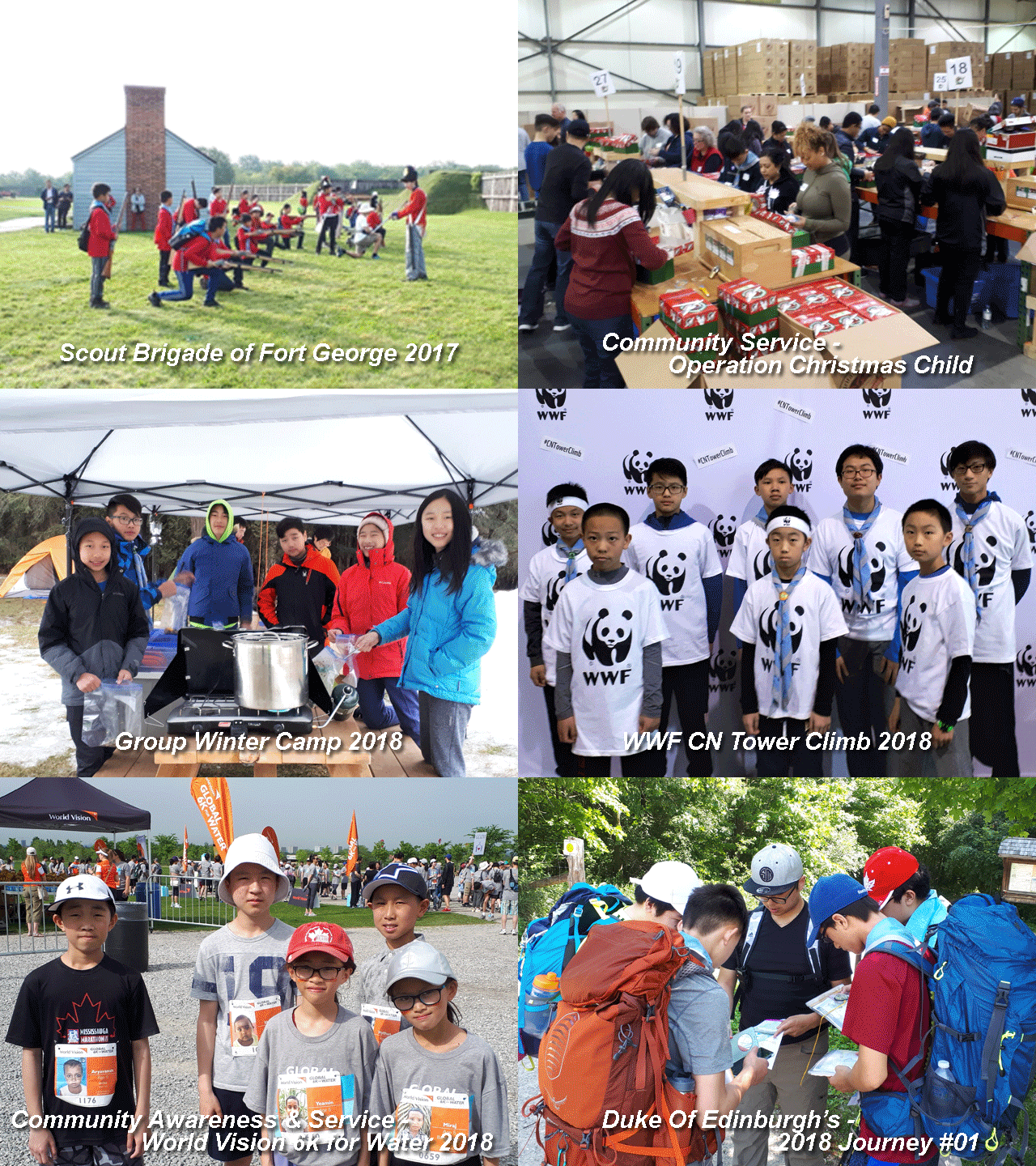
Common ways to implement the Scout method include having Scouts spending time together in small groups with shared experiences, rituals, and activities, and emphasizing good citizenship and decision-making by young people in an age-appropriate manner. Weekly meetings often take place in local centres known as Scout dens. Cultivating a love and appreciation of the outdoors and outdoor activities is a key element. Primary activities include camping, woodcraft, aquatics, hiking, backpacking, and sports.
Camping is most often arranged at the unit level, such as one Scout troop, but there are periodic camps (known in the US as "camporees") and "jamborees". Camps occur a few times a year and may involve several groups from a local area or region camping together for a weekend. The events usually have a theme, such as pioneering. World Scout Moots are gatherings, originally for Rover Scouts, but mainly focused on Scout Leaders. Jamborees are large national or international events held every four years, during which thousands of Scouts camp together for one or two weeks. Activities at these events will include games, scoutcraft competitions, badge, pin or patch trading, aquatics, woodcarving, archery and activities related to the theme of the event.
In some countries a highlight of the year for Scouts is spending at least a week in the summer engaging in an outdoor activity. This can be a camping, hiking, sailing, or other trip with the unit, or a summer camp with broader participation (at the council, state, or provincial level). Scouts attending a summer camp work on merit badges, advancement, and perfecting scoutcraft skills. Summer camps can operate specialty programs for older Scouts, such as sailing, backpacking, canoeing and whitewater, caving, and fishing.
At an international level Scouting perceives one of its roles as the promotion of international harmony and peace. Various initiatives are in train towards achieving this aim including the development of activities that benefit the wider community, challenge prejudice and encourage tolerance of diversity. Such programs include co-operation with non-scouting organisations including various NGOs, the United Nations and religious institutions as set out in The Marrakech Charter.
Uniforms
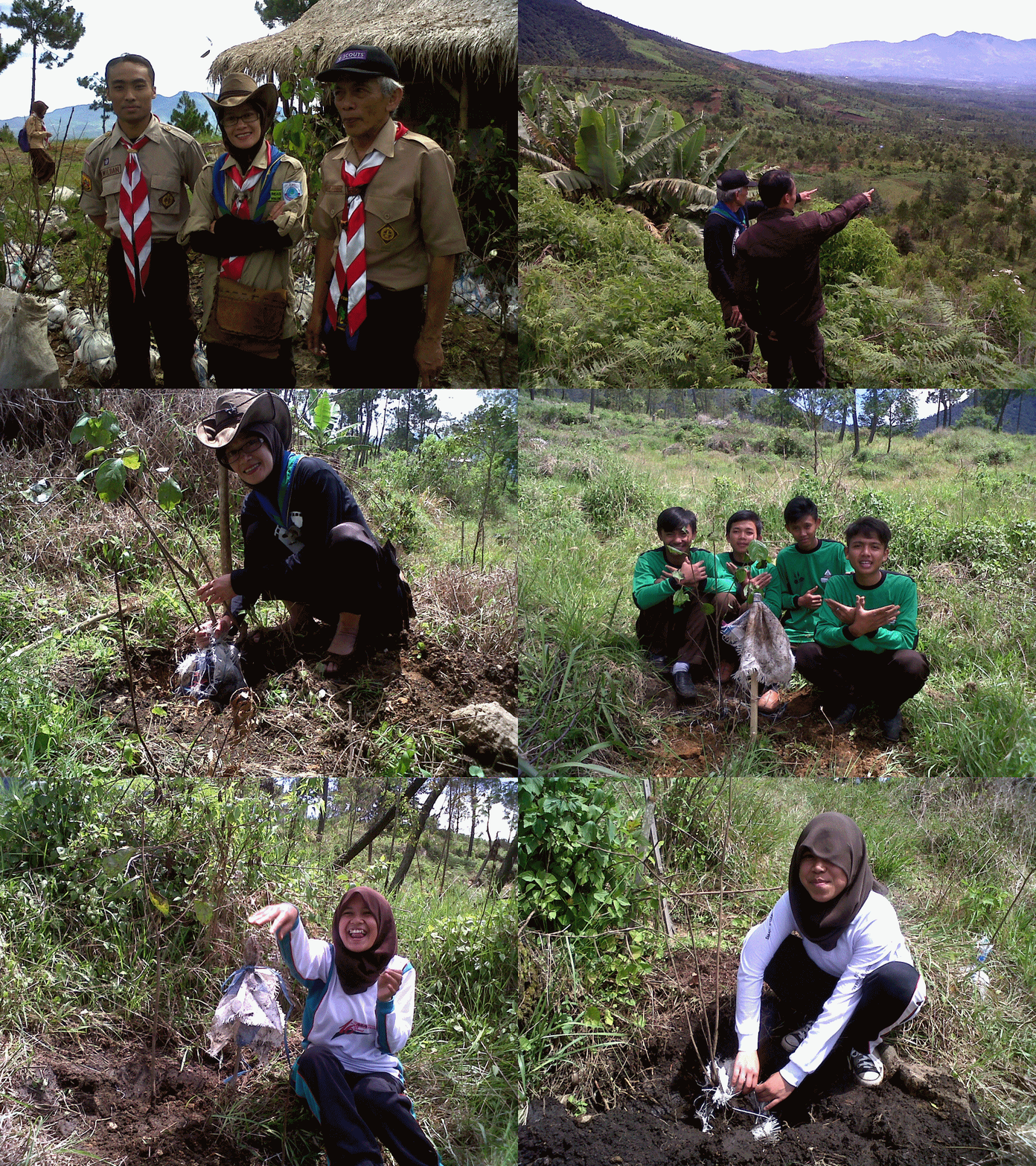
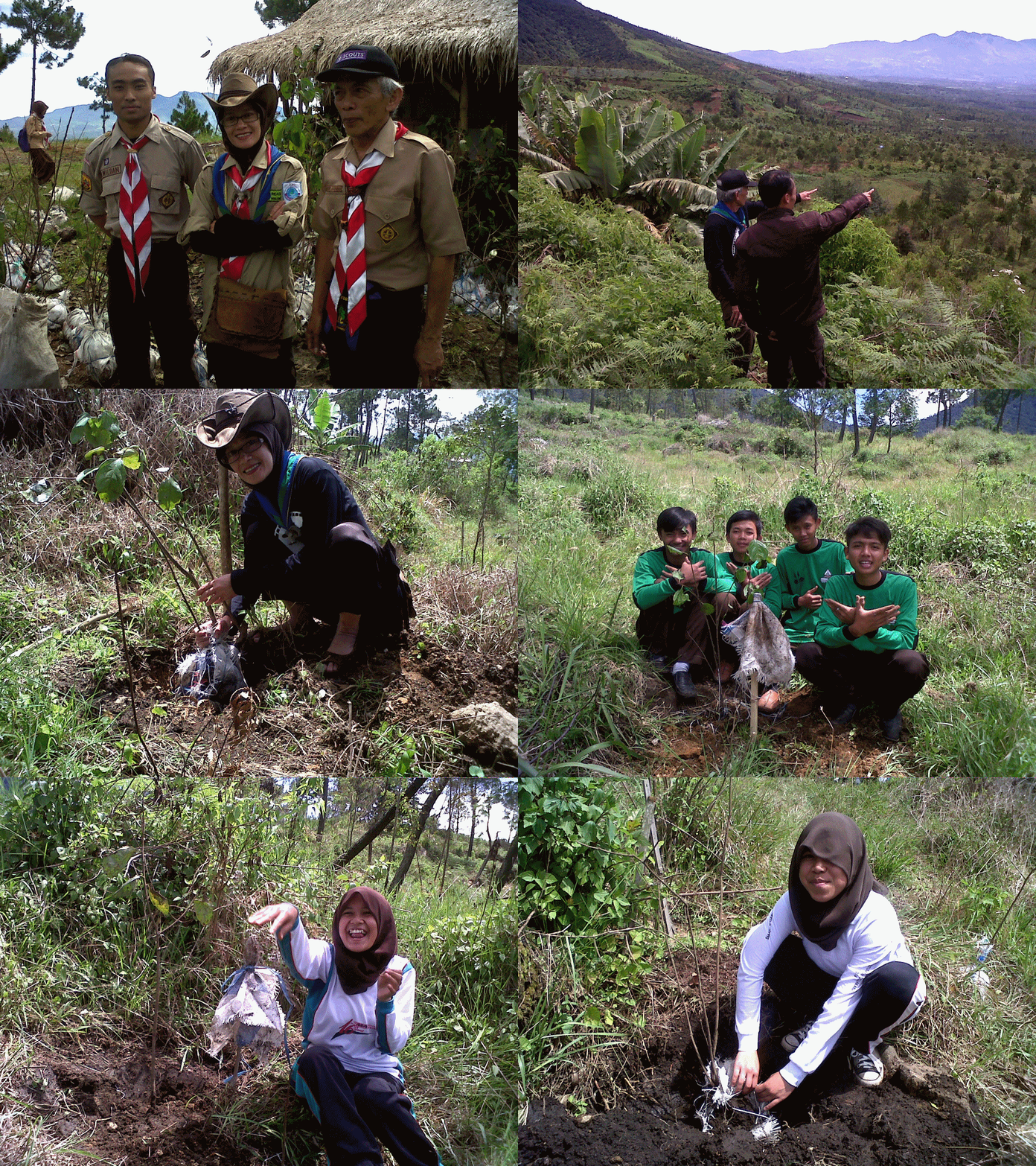
The Scout uniform is a widely recognized characteristic of Scouting. In the words of Baden-Powell at the 1937 World Jamboree, it "hides all differences of social standing in a country and makes for equality; but, more important still, it covers differences of country and race and creed, and makes all feel that they are members with one another of the one great brotherhood". The original uniform, still widely recognized, consisted of a khaki button-up shirt, shorts, and a broad-brimmed campaign hat. Baden-Powell also wore shorts, because he believed that being dressed like a Scout helped to reduce the age-imposed distance between adult and youth. Uniform shirts are now frequently blue, orange, red or green and shorts are frequently replaced by long trousers all year or only in winter.
While designed for smartness and equality, the Scout uniform is also practical. Shirts traditionally have thick seams to make them ideal for use in makeshift stretchers—Scouts were trained to use them in this way with their staves, a traditional but deprecated item. The leather straps and toggles of the campaign hats or Leaders' Wood Badges could be used as emergency tourniquets, or anywhere that string was needed in a hurry. Neckerchiefs were chosen as they could easily be used as a sling or triangular bandage by a Scout in need. Scouts were encouraged to use their garters for shock cord where necessary.
Distinctive insignia for all are Scout uniforms, recognized and worn the world over, include the Wood Badge and the World Membership Badge. Scouting has two internationally known symbols: the trefoil is used by members of the World Association of Girl Guides and Girl Scouts (WAGGGS) and the fleur-de-lis by member organizations of the WOSM and most other Scouting organizations.
The swastika was used as an early symbol by the British Boy Scouts and others. Its earliest use in Scouting was on the Thanks Badge introduced in 1911. Lord Baden-Powell's 1922 design for the Medal of Merit added a swastika to the Scout fleur-de-lis to symbolize good luck for the recipient. Like Rudyard Kipling, he would have come across this symbol in India. In 1934, Scouters requested a change to the design because of the later use of the swastika by the German National Socialist Workers (Nazi) Party. A new British Medal of Merit was issued in 1935.
Age Group & Section-Scouting and Guiding movements are generally divided into sections by age or school grade, allowing activities to be tailored to the maturity of the group's members. These age divisions have varied over time as they adapt to the local culture and environment.
Scouting was originally developed for adolescents—youths between the ages of 11 and 17. In most member organizations, this age group composes the Scout or Guide section. Programs were developed to meet the needs of young children (generally ages 6 to 10) and young adults (originally 18 and older, and later up to 25). Scouts and Guides were later split into "junior" and "senior" sections in many member organizations, and some organizations dropped the young adults' section. The exact age ranges for programs vary by country and association.